

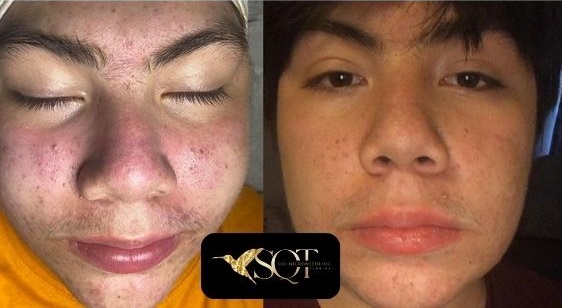
In the world of professional skincare, results speak louder than words. While we can discuss the science of biomicroneedling, the ultimate question from every practitioner is: Does SQT really work for acne scars? This professional case study provides a definitive answer. We will walk you through a real-world client journey, showcasing a dramatic transformation and providing tangible proof of SQT’s efficacy in acne scar treatment. Seeing is believing, and these SQT before and after results are a testament to the power of our technology.
The Client’s Profile: A History of Severe Acne and Scarring
To understand the magnitude of the transformation, we must first understand the starting point.
Initial Skin Condition Assessment
Our case features a 28-year-old male client with a history of persistent, severe cystic acne throughout his teenage and early adult years. While the active acne had subsided, it left behind significant textural damage. His skin type was oily and prone to congestion.
Key Concerns: Pitted Scars and Uneven Texture
The client’s primary concerns were:
- Pitted Scars: Multiple atrophic and boxcar scars across both cheeks.
- Enlarged Pores: Prominent pores, particularly in the T-zone.
- Uneven Texture: A rough, uneven skin surface that lacked smoothness and radiance.
The Professional Assessment and SQT Treatment Protocol
A thorough assessment led to a customized, multi-faceted treatment plan designed to address both scarring and overall skin health.
Designing a Combined Protocol: Repair and Nourishment
Given the depth of the scars and the client’s oily skin, a combined protocol was designed. The strategy was to first powerfully resurface the skin to break down scar tissue, and then deeply nourish it to support healthy, new collagen formation.
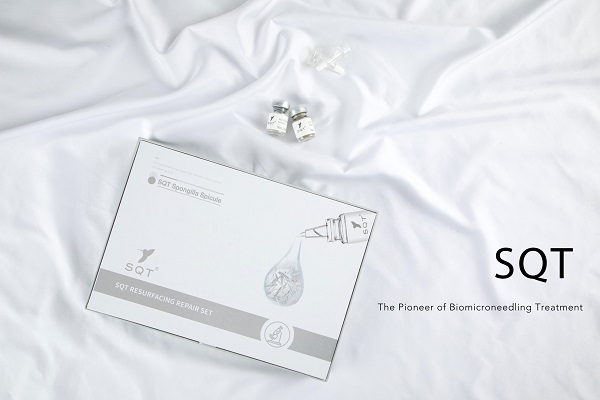
Utilizing the SQT® Resurfacing Repair Set
The core of the treatment was the SQT® Resurfacing Repair Set. This set was chosen for its proven ability to improve acne-prone skin, fade marks, and refine texture. It was the primary tool for the resurfacing phase.
The Treatment Schedule and Timeline
The treatment schedule consisted of four SQT biomicroneedling sessions, spaced four weeks apart. This timeline allowed the skin adequate time for recovery and regeneration between each intensive treatment, maximizing the SQT results at each stage.
The Transformation Journey: SQT Before and After Photos
The following unretouched photos document the remarkable progress throughout the treatment course.
Baseline: The Skin Before Treatment The initial photo clearly shows the significant pitted scars and overall rough texture that were the client’s main concerns.
Mid-Point: Progress After Two Sessions
After just two treatments, a noticeable improvement is visible. The scar edges are less sharp, and the skin’s surface has begun to look smoother.
The Final Result: A Dramatic Skin Texture Improvement The final photo showcases a dramatic skin texture improvement. The SQT before and after comparison is undeniable.
Analyzing the Results: A Deep Dive into Skin Texture Improvement
These visual results are backed by clear, observable changes in the skin’s structure and health.
Quantifying the Reduction in Scar Depth
A close analysis of the photos reveals a significant reduction in scar depth. The once-deep depressions have been visibly “filled in” as new collagen and elastin were produced, creating a more level skin surface.
Observing the Minimization of Pore Size
In addition to scar improvement, there was a visible minimization of pore size. The treatment helped to clear out congestion and tighten the surrounding tissue, leading to a more refined appearance.
The Overall Enhancement of Skin Smoothness
The most impactful result was the overall improvement in skin smoothness and radiance. The uneven texture was replaced by a healthier, more uniform complexion, showcasing a true real transformation.
The Client’s Testimonial: A Word on Their Experience
The clinical results were matched by the client’s personal satisfaction.
Regaining Confidence
In his own words, the client stated, “I never thought the texture of my skin could improve this much. I spent years feeling self-conscious, and this treatment has given me a level of confidence I didn’t think was possible.” This journey was about more than just skin; it was about regaining confidence.
Feedback on the Treatment Process
He also commented on the experience itself: “The process was far more comfortable than I expected. There was minimal downtime, and my esthetician provided clear instructions for aftercare, which made everything easy.”
Real Evidence of SQT’s Power in Acne Scar Treatment
This professional case study provides clear, tangible evidence of SQT’s effectiveness. The remarkable SQT before and after results demonstrate that our biomicroneedling technology is a powerful and reliable tool for advanced acne scar treatment. It is a solution that delivers not just visible skin texture improvement, but also a profound boost in client confidence and satisfaction.
Do you have clients struggling with stubborn acne scars? See the full potential of our Resurfacing Repair Set and start creating your own success stories.
Frequently Asked Questions About Treating Acne Scars with SQT
How many SQT sessions are typically needed for acne scars? The number of sessions depends on the severity and type of scarring. While visible improvement can be seen after 1-2 sessions, a course of 4-6 treatments is typically recommended for significant, long-lasting results.
Is this acne scar treatment suitable for all types of scars? SQT biomicroneedling is highly effective for atrophic scars, such as boxcar and rolling scars, as it helps rebuild lost collagen. It is generally not recommended for hypertrophic or keloid scars. A professional consultation is essential.
What is the expected downtime for this specific protocol? The downtime is minimal. Clients typically experience mild redness for 24-48 hours, followed by possible light flaking around day 3-5. Most clients can resume normal social activities immediately or the next day. For any professional queries about designing a protocol, please contact our expert team.